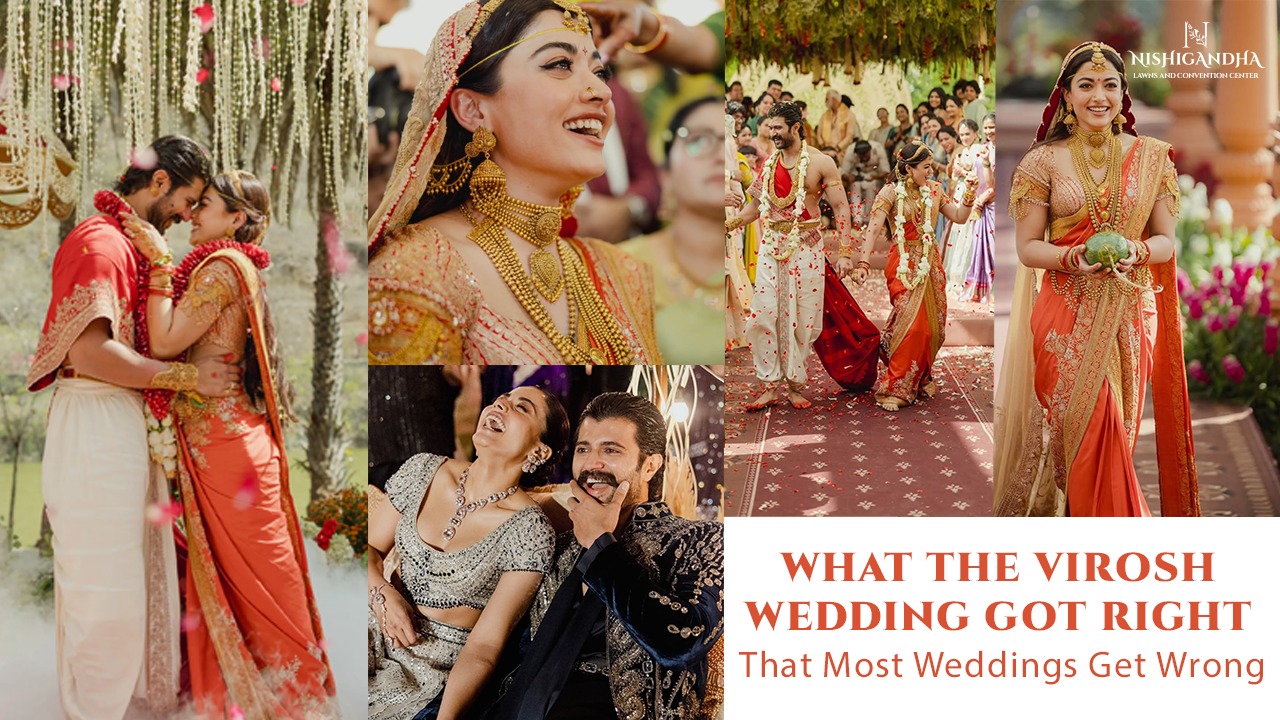
Most celebrity weddings trend because of what they looked like. The Virosh wedding trended because of what it meant.
That is not a small distinction. Rashmika Mandanna and Vijay Deverakonda’s three-day wedding in Udaipur last February generated the kind of response that most PR teams spend years trying to manufacture and never quite achieve. Strangers crying in comment sections. Brides forwarding photographs to their mothers at midnight. People who had never watched a single film from either of them saying things like “this is the wedding I didn’t know I wanted.”
None of that happened because of the designer names on the outfits. It happened because of the decisions behind them. And those decisions are worth understanding, because almost all of them are available to any couple, at any budget, planning a wedding anywhere.
They Chose Meaning Over Mood Board
The easiest thing to do when planning a high-profile wedding is to find the most beautiful references and execute them well. Good venue. Good designer. Good photographer. The result is almost always stunning, almost always forgettable.
The Virosh wedding was built differently. Every single element, from the custom mural at the Haldi to the embroidery on the reception blouse, traced back to something specific. A cultural tradition. A family gesture. A personal detail that only made sense if you knew who these two people actually were.
The Haldi is a good example. Yes, it was beautifully decorated: citrus tones, fresh lilies and marigolds, and a rose petal floor. But the detail that stopped people was a custom-illustrated backdrop featuring their two pets, drawn as characters driving a yellow vintage convertible together. It was not the most expensive element in the setup. It was the most personal. And personal, it turns out, photographs better than expensive every single time.
That one illustration told you: these people thought about what made them different, not what makes a Haldi look good in general. There is a version of this available to every couple. It just requires asking a different question at the planning stage. Not what looks beautiful but what is specifically, irreducibly ours.
They Let Culture Do the Heavy Lifting
One of the quieter revolutions in the Virosh wedding was the complete absence of apology around tradition.
Telugu and Kodava traditions were observed in full, on the same day, with the same weight given to each. The Pradhanam, a Telugu engagement ritual involving a ring hidden in a pot of milk and rose petals, was included not because it photographed well but because it mattered.
And then there were the clothes. Not as fashion. As communication. The mehendi design carried sacred symbols across two languages on Rashmika’s hands. The reception saree had the state emblem of Karnataka woven into it and the weapons of the Kodava community embroidered on the blouse. By the end of the three days, you did not need a caption to understand who these people were, where they came from, or what they were carrying into their marriage.
This is what culture does when you actually let it in. It gives your wedding a texture that no decorator or stylist can manufacture. It makes strangers feel something, because authenticity travels across context in a way that aesthetics simply does not.
The broader trend this points to is significant. After years of weddings that leaned heavily on imported aesthetics: European florals, generic luxury hotel setups, outfits that could have been worn at any wedding in any city, there is a real and growing appetite for the specific. For the regional textile. For the ritual that takes forty minutes and confuses half the guest list but moves the other half to tears. For the saree gifted by a mother-in-law worn to the mandap instead of a custom bridal commission.
They Made the Pre-Wedding Functions Count for Something
There is a tendency to treat pre-wedding functions as warm-up acts. The Sangeet is where you show off the choreography. The Haldi is where you take the fun photographs. The Mehendi is where things start to feel real.
What these functions shared was intention. Each one was designed to be genuinely experienced by the people in the room, not primarily documented for people outside it. And the great irony is that this approach produces far better documentation than the reverse. The photographs from the Virosh Haldi, the Sangeet speeches, the Mehendi portraits: they circulated because they looked like real life at its most heightened, not like a production still.
The practical lesson here is almost counterintuitive: invest less in what the function looks like and more in what happens inside it. One surprise performance from a parent will outlast any floral installation. A ritual that most guests have never seen before will be talked about for years. A nickname on a name card will break the internet faster than a drone show. Vijay’s name for Rashmika, Rushie, which fans saw for the first time at the Haldi, is proof of that.
They Kept It Small Enough to Feel Real
The Virosh wedding had a small guest list. Deliberately. At a time when Indian weddings have trended increasingly toward scale, more guests, more functions, and more spectacle, the choice to keep the celebration intimate was itself a statement.
Small guest lists do something specific to the energy of a wedding. Everyone present is genuinely meant to be there. The couple can actually see the faces in the room. The rituals land differently when they are being witnessed by fifty people who love you rather than five hundred who know someone who knows you.
This is harder to talk about as a trend because it runs against a lot of conventional wedding logic. The guest list is often the most politically complicated part of any planning process. But the emotional intelligence of the Virosh wedding is inseparable from its scale. The moments that moved people, the mother’s dance, the speeches, the two ceremonies observed in full, the couple visibly present in every photograph, all of it required an environment where presence was actually possible.
The Real Trend Is Intention
Strip the Virosh wedding of every designer name, every Udaipur backdrop, every celebrity context, and what remains is a very simple set of priorities.
Know who you are. Honour where you come from. Include the people who matter in ways that actually include them. Do not abbreviate the things that are important because they are inconvenient. Choose the detail that is specifically yours over the detail that looks generally good.
None of this is new. All of it is, apparently, rare enough that when someone actually does it, fully and without hedging, it stops people in their tracks. That is the trend the Virosh wedding set. Not a colour, not a silhouette, not a floral arrangement. A way of approaching the whole thing.
Bringing It to Your Own Wedding
The reason the Virosh wedding’s philosophy travels is that it is not dependent on budget or geography. A custom pet illustration costs less than a premium centrepiece. A full cultural ceremony costs nothing but time and the willingness to do it properly. A saree gifted by a mother is already in someone’s cupboard.
What it does require is a venue and a team that give you the room to do things your way. Spaces flexible enough to hold two ceremonies, outdoor lawns that support the kind of natural, living setups that make a Haldi feel like a celebration rather than a shoot, and the infrastructure for a sangeet that runs until 4 AM because it was too good to end on schedule.
For couples planning a wedding in Pune, whether you’re exploring wedding lawns in the city, looking at convention halls in Pune for a larger function, or considering a more intimate destination-style setting around Hinjewadi or Mulshi, the venue conversation is really a conversation about how much space you have to be yourselves.
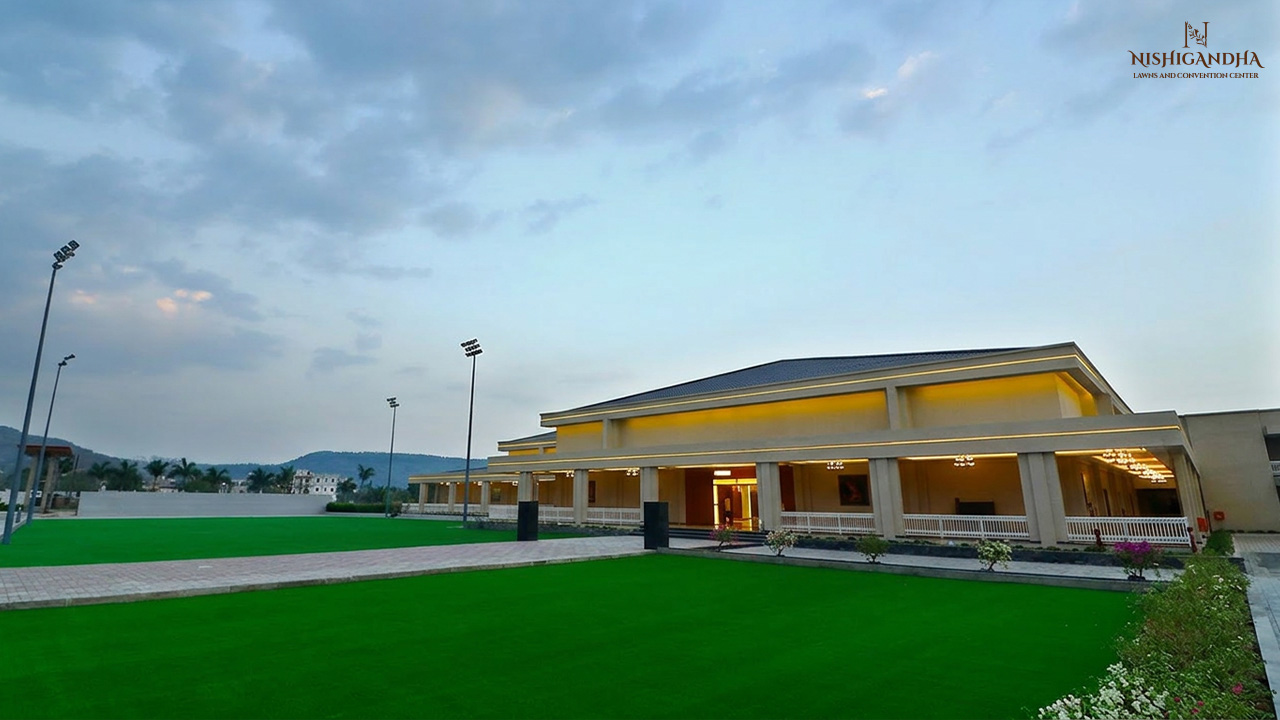
Nishigandha Lawns and Convention Centre in Hinjewadi is worth a visit before you decide. Open lawns, full indoor convention facilities, and the flexibility to run each function on its own terms. Which is, as it turns out, exactly the kind of space where a wedding built on intention rather than template actually comes to life.